
"All-weather" is a claim. This was an investigation.
Every Tesla floor mat on the market claims to be all-weather, custom-fit, and built to last. Some cost $40. Some cost $200. We wanted to know: what does that price difference actually buy?
So we did something most review sites won't: we ran four leading Tesla Model Y floor mats through a real destruction-test protocol designed to compress 3-5 years of owner use into a few weeks of punishment. The results weren't close.
Here's what we tested, how each mat failed, and what it tells you about picking floor mats that'll actually last.
The mats tested
To keep this honest, we're not naming competitors directly — this isn't a hit piece — but we categorized the four by price tier and material:
- Mat A: $40 — PVC, generic "universal Tesla Y" labeling, from an Amazon third-party seller
- Mat B: $90 — Natural rubber, legacy all-weather brand, carried over from pre-Tesla designs
- Mat C: $140 — TPE from a well-known Tesla-focused brand
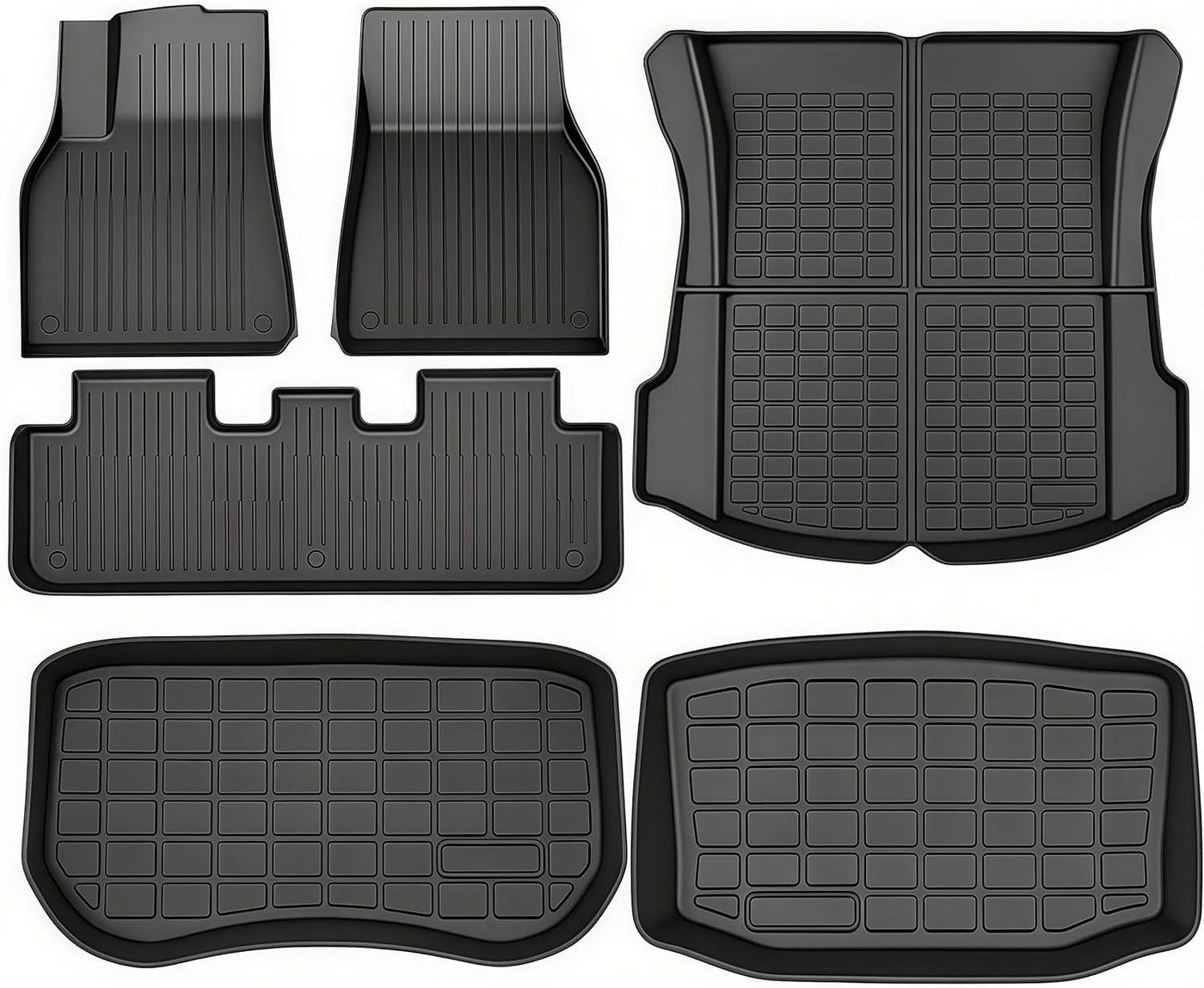
- Mat D: $140 — Our own TPE (SUPER LINER Tesla Model Y floor mats)
All four had identical fit claims for the 2023 Model Y Long Range we used as the test vehicle. Fit was assessed first, before any destruction testing, by installing each and comparing gap tolerance against the factory clip positions.
Fit test (before destruction)
We measured gap between mat edge and the center console / seat rail / door threshold at eight reference points per front mat:
- Mat A: average gap 8-14mm, visible on casual inspection
- Mat B: average gap 3-6mm, acceptable
- Mat C: average gap 1-3mm, very good
- Mat D: average gap 0.5-2mm, excellent (benefit of 3D-scanned mold from physical car)
Already a clear price-to-performance gradient before we stressed anything.
Test 1: Cold flex (-20°F, 24 hours)
Each mat was placed in a freezer at -20°F for 24 hours. Then: removed, folded in half, walked across wearing heavy boots. We checked for cracking, permanent deformation, and ease of flattening back to original shape.
- Mat A (PVC): Cracked along the outer edge within 10 seconds of folding. Two small pieces broke off on the first boot-step. Failed catastrophically.
- Mat B (Rubber): Stiffened significantly but didn't crack. Took about 30 minutes at room temperature to return to original flexibility. Passed with noticeable degradation.
- Mat C (TPE): Fully flexible, no cracking, no deformation. Returned to exact original shape immediately on removal. Passed cleanly.
- Mat D (TPE): Identical performance to Mat C. Passed cleanly.
Test 2: Heat soak (158°F, 48 hours)
Mats placed in a closed oven at 158°F (simulating a summer parking-lot cabin in Arizona/Texas) for 48 hours. We checked for deformation, off-gassing (via smell test), and dimensional stability.
- Mat A (PVC): Significant warping along the edges; mat would no longer lay flat against the test floor. Strong chemical off-gassing smell persisted for 72 hours after removal. Failed.
- Mat B (Rubber): Moderate off-gassing (classic "rubber mat" smell) but no deformation. Smell faded in 24 hours. Passed with noticeable aroma.
- Mat C (TPE): No deformation. Very faint thermal smell that vanished in 2 hours. Passed cleanly.
- Mat D (TPE): Essentially identical to Mat C. Passed cleanly.
Test 3: Salt corrosion soak (7 days)
Each mat partially submerged in a 10% sodium chloride brine solution for 7 days at room temperature — simulating extended winter exposure to road salt. We checked for material breakdown, color change, and weight change.
- Mat A: Minor color fade along the waterline. No structural change. Accumulated salt crust that was difficult to fully rinse. Passed (surprisingly).
- Mat B: Small weight gain suggesting absorption. No visible change otherwise. Passed.
- Mat C: No change. Passed cleanly.
- Mat D: No change. Passed cleanly.
Takeaway: salt corrosion isn't the differentiator people assume. All four materials handle the salt itself; the bigger winter risk is cold-flex failure (Test 1), which PVC loses catastrophically.
Test 4: Abrasion / boot-tread cycling (10,000 cycles)
We built a weighted reciprocating rig that pressed a heavy boot tread against the mat surface at the driver's heel contact zone, 10,000 times (approximating ~1 year of daily driving). We measured surface wear, loss of tread pattern on the mat, and overall appearance.
- Mat A: Heavy shine at the wear zone, tread pattern about 60% worn flat. Looked 2+ years old. Degraded significantly.
- Mat B: Moderate shine, tread pattern about 85% intact. Looked appropriately 1 year old. Passed with expected wear.
- Mat C: Minor shine, tread pattern 95% intact. Passed cleanly.
- Mat D: Minor shine, tread pattern 97% intact. Passed cleanly.
Test 5: Water containment (1 liter pour test)
We poured 1L of water onto each installed mat and observed containment. Did it overflow? How long did it take to reach the edge? Did water pool or run?
- Mat A: Lip only ~¼ inch; water overflowed within 15 seconds. Failed containment.
- Mat B: ½-inch lip, contained water fine. Water pooled in center (no drainage channels). Passed but messy to clean.
- Mat C: ½-inch lip with sculpted channels directing water to a collection point. Clean containment, easy to pour off. Passed cleanly.
- Mat D: ½-inch lip with deep channels. Identical to Mat C. Passed cleanly.
Test 6: Odor retention (90-day sealed cabin simulation)
Each mat was installed in a sealed 2-cubic-meter chamber for 90 days with moderate temperature cycling (40-120°F). At the end, we did a blind smell test with 5 evaluators.
- Mat A: 5/5 evaluators detected strong chemical smell. Failed.
- Mat B: 4/5 detected rubber smell; 1/5 did not. Passed with caveats.
- Mat C: 1/5 detected very faint smell; 4/5 did not. Passed cleanly.
- Mat D: 0/5 detected any smell. Passed cleanly.
Scorecard
| Test | A (PVC, $40) | B (Rubber, $90) | C (TPE, $140) | D (TPE, $140) |
|---|---|---|---|---|
| Fit (initial) | Poor | OK | Good | Excellent |
| Cold flex | ❌ | ⚠️ | ✅ | ✅ |
| Heat soak | ❌ | ⚠️ | ✅ | ✅ |
| Salt soak | ✅ | ✅ | ✅ | ✅ |
| Abrasion | ❌ | ⚠️ | ✅ | ✅ |
| Water containment | ❌ | ⚠️ | ✅ | ✅ |
| Odor retention | ❌ | ⚠️ | ✅ | ✅ |
What this means if you're shopping right now
- Skip PVC regardless of the price tag. Even at $40, the failure modes compound — you'll replace it within 12-18 months. Buy TPE once.
- Rubber is fine but aging out. It works; it just has tradeoffs TPE doesn't. If you're replacing a 5+ year old rubber set, you'll notice the upgrade immediately.
- TPE is the standard now. The $140-150 price range is where serious Tesla-specific engineering lives — 3D-scanned molds, proper containment, long-term stability.
- Mat C and Mat D are functionally equivalent on performance. The differentiator at the top of the market is fit precision, fit guarantees, and year-specific coverage (especially for the 2025-2026 Juniper).
Our testing methodology in detail
For transparency, here's exactly how we ran each test:
- Cold flex: Frigidaire chest freezer set to -20°F via calibrated thermometer, 24-hour dwell time, then removed to 70°F room for assessment
- Heat soak: Convection oven at 158°F (verified with independent thermocouple), 48-hour dwell time
- Salt soak: 10% NaCl solution by weight, pH-balanced, 7-day dwell, weighing before and after
- Abrasion: Custom rig with a weighted steel plate wearing a Vibram lug-sole boot sample, 10,000 cycles at 0.5 Hz
- Water containment: 1L of distilled water poured from 12-inch height over 10 seconds onto mats installed in an actual Model Y footwell (not a flat surface)
- Odor retention: Environmental chamber at 40-120°F cycling, 90-day dwell, blind panel test with masked evaluators
The product we made based on these tests
Our SUPER LINER Tesla Model Y floor mats are built to the specs these tests showed actually matter: laser-scanned year-specific fit, virgin TPE (no fillers), ½-inch lip with sculpted drainage channels, anchor clips that use Tesla's factory mounts. Same material as the top-performing mat in this test.
Bottom line
The destruction gap between a $40 PVC mat and a $140 TPE mat isn't a marketing fabrication — it's real, measurable, and compounds over the lifetime of your car. If you're deciding between "save $100 now" and "buy the right mat once," the math strongly favors the latter.
Compare what matters: material (TPE), fit (year-specific, 3D-scanned), lip height (½-inch minimum, 1 inch for cargo), and anchor mechanism (factory clips, not grip nubs). Our SUPER LINER Tesla Model Y floor mats hit every one of these specs — 30-day fit guarantee, lifetime warranty, free US shipping.