
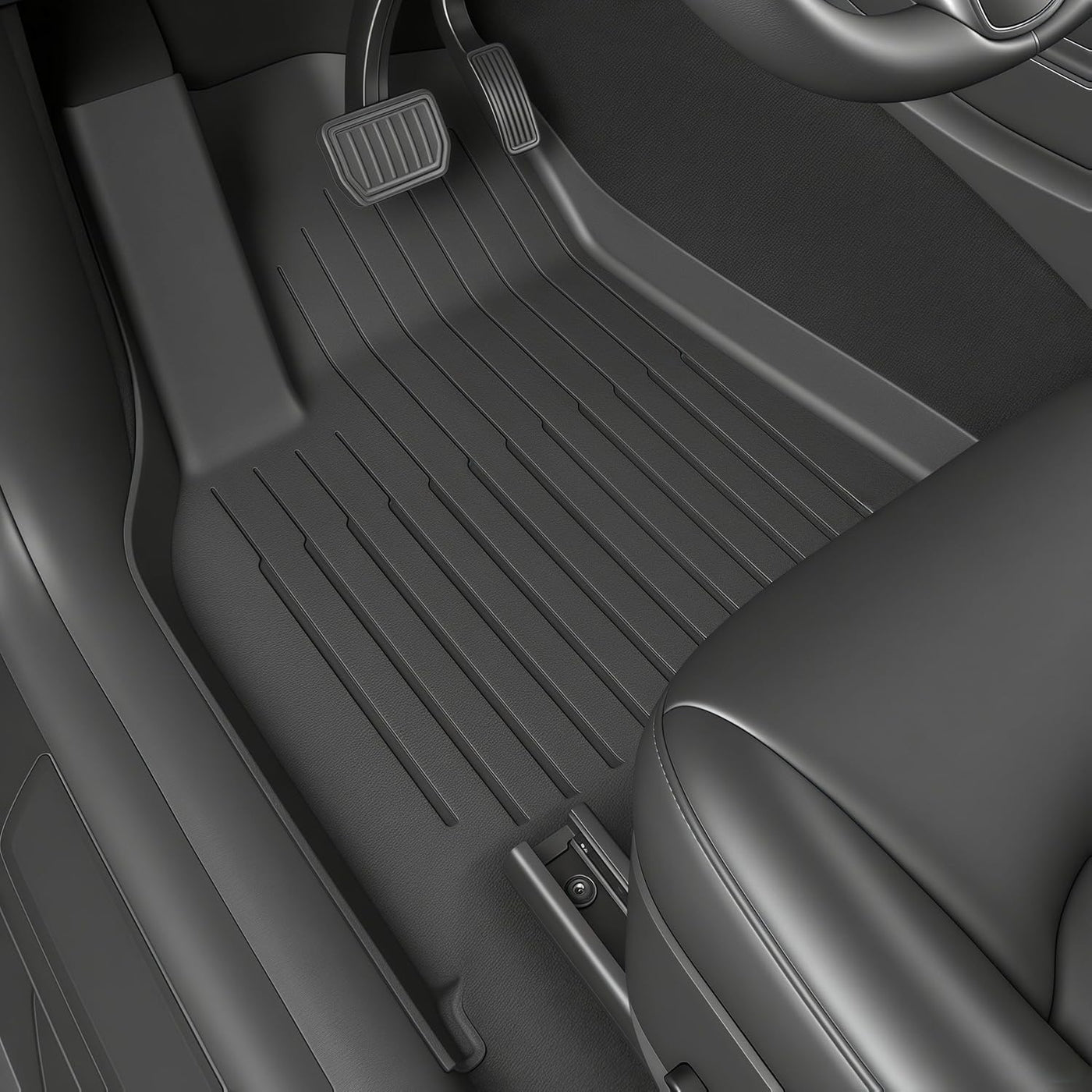
"All-weather" means four different things from four different vendors
Shop for Tesla Model Y floor mats for ten minutes and you'll see the same marketing words from every brand: "all-weather," "heavy-duty," "custom-fit." What rarely gets mentioned in plain language is what the mat is actually made of, and that's the single biggest predictor of whether it'll still look good in three years.
There are four materials dominating the Tesla floor mat market: TPE, natural rubber, carpet, and PVC. Each behaves very differently inside a Tesla's sealed, always-climate-controlled cabin. Here's a direct comparison, with the tradeoffs called out honestly.
TPE (Thermoplastic Elastomer) — the current gold standard
What it is: An engineered polymer that behaves like rubber (flexible, grippy) but with the manufacturing precision of a thermoplastic (can be molded to 3D-scanned tolerances). Originally developed for automotive seals and dashboards.
Temperature range: -40°F to 158°F without cracking or deforming.
Pros:
- Stays flexible in extreme cold — won't crack when you step on a frozen corner
- Doesn't soften or off-gas in hot summer cabins (critical in Arizona / Texas / Florida)
- Odor-neutral — no "new rubber mat" smell that lingers in a sealed EV
- Can be precisely 3D-molded for year-specific fit
- Recyclable and typically phthalate-free
- Holds up to salt, road grime, coffee, and dog fur
Cons:
- More expensive than PVC or cheap rubber (you get what you pay for)
- Not all "TPE" is created equal — bargain-brand TPE often has fillers that compromise the benefits
Best for: Anyone who plans to own the car more than 18 months, lives in a climate with real winters or real summers, or just wants the closest thing to "install and forget" that exists in floor mats.
This is what we make. Our premium TPE Tesla Model Y mats are laser-scanned from physical cars and molded from virgin TPE (no filler).
Natural rubber — the old standard
What it is: The material most traditional "all-weather" floor mats have been made from for decades. WeatherTech, Husky, and other long-established brands use variations of natural rubber compounds.
Temperature range: Varies by compound, typically -20°F to 120°F before compromise.
Pros:
- Proven material with decades of real-world data
- Naturally grippy — doesn't slide as readily as PVC
- Handles heavy boots and abuse well
Cons:
- Gets stiff below -20°F (cracking risk in northern climates)
- Can off-gas in hot cabins — that classic "rubber mat" smell is real and doesn't fully fade in a sealed EV
- Latex allergy concern for a small percentage of users
- Typically heavier than TPE (harder to pull out for cleaning)
- Older molding techniques can't match the precision fit of modern 3D-scanned TPE
Best for: Traditionalists who trust the old brands and don't mind the tradeoffs. Still a solid choice — just no longer the best-in-class.
Carpet — the factory default (and an upgrade most owners skip)
What it is: Loop-pile or cut-pile carpet mats, usually with a rubber backing and edge binding. Tesla's original all-weather upgrade mats are carpet with rubber backing. Most aftermarket "luxury" carpet mats are in this category.
Pros:
- Feels premium underfoot, looks upscale
- Soft on bare feet, pleasant for passengers
- Absorbs small amounts of water without pooling
Cons:
- Stains from anything — coffee, soda, salt water, mud all leave permanent marks
- Traps odors (dog, food, gym bag) — once embedded, nearly impossible to fully remove
- Can't be hosed down — dry vacuum only
- Absorbs road salt brine, which corrodes metal underneath over time
- Shorter lifespan than TPE or rubber in any climate
Best for: Dry climates only (Southern California, Arizona interior, low-humidity areas) where the car will never see mud, snow, or liquid spills. In those conditions, carpet is a legitimate upgrade to the factory mat. Everywhere else, it's a design choice that ages poorly.
PVC (vinyl) — the one to avoid
What it is: Polyvinyl chloride. The cheapest floor mat material, typically found in sub-$50 "universal" or "custom-fit" mats on Amazon and aftermarket sites.
Temperature range: Practical range is roughly 0°F to 100°F before problems start.
Pros:
- Cheap
- Shiny, appears premium in photos
Cons:
- Becomes brittle in cold weather — frozen corners literally shatter
- Often contains phthalates that off-gas in hot cabins (the worst "new car" smell that never goes away)
- Stiffens over time, loses its original shape
- Surface scuffs and scratches easily — the "shiny" factor is gone within weeks
- Hard to recycle
Best for: Nobody, honestly. If you're budget-constrained, buy a secondhand set of TPE mats rather than new PVC. The long-term cost difference is zero because PVC fails so much sooner.
Direct comparison table
| Feature | TPE | Rubber | Carpet | PVC |
|---|---|---|---|---|
| Cold tolerance | -40°F | -20°F | N/A | 0°F |
| Heat tolerance | 158°F | 120°F | N/A | 100°F |
| Can be hosed down | Yes | Yes | No | Yes |
| Odor-neutral in hot cabin | Yes | No | Absorbs odors | No (worst) |
| Typical lifespan | 10+ years | 5-8 years | 3-5 years | 1-3 years |
What about "eco" materials and plant-based claims?
Several brands now market "plant-based" or "bio-TPE" mats. Read the fine print — most of these are TPE with 10-20% renewable content, still majority synthetic. That's fine, and directionally the right move, but don't pay a 50% premium expecting a material breakthrough. The performance characteristics are essentially identical to standard TPE.
How to pick for your situation
- Northern climates / real winters: TPE (only).
- Hot Southern climates: TPE (PVC fails fastest in heat).
- Pets or kids: TPE with a one-piece rear mat.
- Dry, temperate, low-use: Carpet is acceptable.
- Sub-$50 budget: Buy secondhand TPE, not new PVC.
Bottom line
TPE is the current best-in-class for Tesla floor mats and has been for about 5 years. The reason most specialty Tesla brands use TPE isn't marketing — it's that the material genuinely outperforms the alternatives across the range of conditions a Model Y actually sees.
If you're ready to upgrade from stock carpet, start with our premium TPE Tesla Model Y mats. Laser-fit for every model year including the 2025-2026 Juniper refresh, with a 30-day fit guarantee and lifetime warranty.